

How Many Backlinks Do I Need to Rank? Work Out Your Number

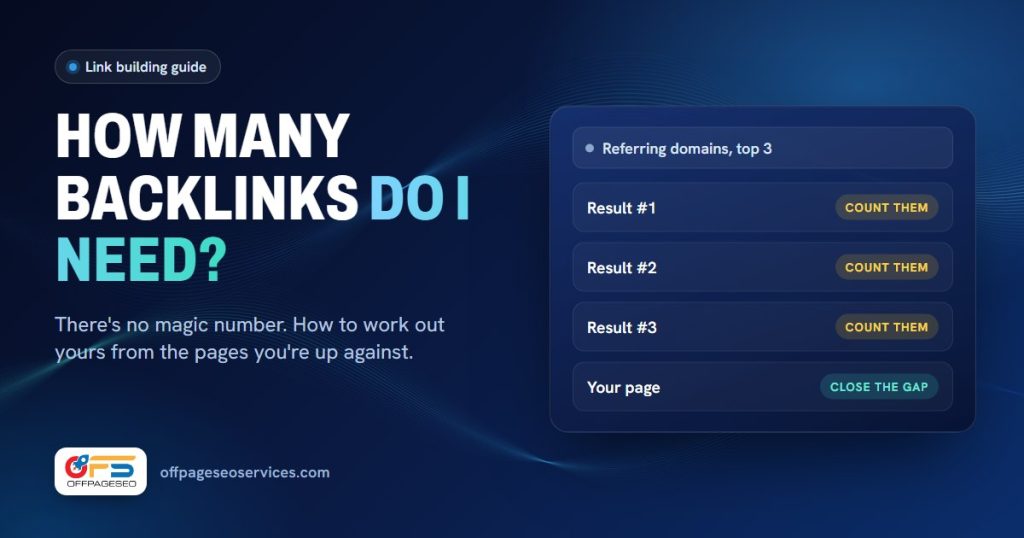
There’s no set number of backlinks you need. The number that matters is how many good sites link to the pages already ranking for your keyword, compared with how many link to yours. For an easy keyword that can be a handful, or none. For a hard one it can be hundreds, and buying links may not be the right way to close that gap.
We sell links, so a big number would suit us. It wouldn’t be honest. This guide shows you how to work out your own number, what Google has said about links, and when more links won’t help.
Key takeaways
- Google has never published a number. Its Gary Illyes has said “We need very few links to rank pages”.
- Your number comes from the top results for your keyword. Count the sites linking to them, not the total links.
- Ahrefs found that of ~20 million pages with no referring domains, only 2,997 get more than 1K search visits a month.
- One link from a site with real traffic is worth more than ten from sites with none.
- There’s no safe number per month. A steady pace that matches your site’s growth is the lower-risk choice.
How many backlinks do I need to rank?
As many good referring domains as it takes to compete with the pages above you, and no fixed number beyond that. Look at the top 3 results for your keyword and count the different sites linking to each page. If your page is as good as theirs, that range is your target, not a figure from a blog post.
Google has played down the idea that more links always win. At SERP Conf in April 2024, Google’s Gary Illyes said: “We need very few links to rank pages… Over the years we’ve made links less important.” That was reported by Search Engine Roundtable, from notes taken at the talk.
“Very few” isn’t zero, though. The pages that rank for competitive keywords almost always have links from many sites. The question is how many your keyword needs, and only the results page can tell you that.
Do pages without backlinks get traffic?
Some do, but very few. Ahrefs looked at its index and found ~20 million pages with no referring domains. Only 2,997 of them get more than 1K search visits a month, roughly 1 in every 6,671. Ahrefs adds that almost all of those pages are about low-competition topics.
Those figures are from Ahrefs’ search traffic study, published in December 2023. The same study found that “96.55% of all pages in our index get zero traffic from Google”. It also found “a clear correlation between the number of websites linking to a page and its traffic”, and it’s careful to say that “correlation does not imply causation.”
So links and traffic tend to go together, but a link doesn’t guarantee a ranking. The page still has to be the best answer for the search.
How do you work out your own number?
Search your keyword, take the top 3 organic results, and check how many referring domains point to each of those pages in a tool like Ahrefs or Semrush. Compare that range with your page’s count. The difference is your link gap, and it tells you roughly how many sites you need.
- Search the keyword in the country you’re targeting, logged out. Skip ads, maps and big brands you can’t realistically compete with.
- Count referring domains to each page, not the whole site. A page with 400 links from 3 sites has 3 referring domains, and that’s the number that counts.
- Note how strong each site is. A strong site can rank a page with fewer links of its own.
- Use the middle of the range, not the highest. If one result is a huge brand, leave it out.
- Subtract your page’s referring domains. That’s your gap.
- Check that your page matches the search before you count on links. If the top results are guides and yours is a sales page, fix that first.
Here’s how to read what you find:
| What the top 3 look like | What it means | What to do |
|---|---|---|
| Few or no referring domains, weak sites | Content decides this one | Write a better page first. A few good links may be enough |
| A small number of links, sites like yours | A realistic target | Close the gap over a few months with relevant links |
| Many referring domains, strong sites | A hard keyword | Target a longer keyword first and build up the site |
| Big brands and very strong sites only | Links alone won’t get you there | Pick another keyword, or treat this as a long-term goal |
Is one good backlink better than ten weak ones?
Usually, yes. A link from a relevant site with real visitors can help, while links from spammy or empty sites are often ignored. Google said in its December 2022 link spam update that “spammy links are neutralized”. Ten of those can add up to nothing, and they cost money and add risk.
That line is from Google’s announcement of the update. Our view is simple: a link from a site with real traffic beats ten from sites with none. Ahrefs’ 96.55% figure shows how many pages get no search visits at all, and plenty of sites that sell links are full of them.
Before you pay for any link, check the site. Our list of checks for a guest post site takes about 10 minutes.
How many backlinks per month is safe?
There’s no safe number, and Google hasn’t published one. Risk comes from what the links are and how they look, more than from a count. A steady pace that fits your site’s size looks like normal growth. A sudden burst of paid links on a young site looks like a purchase.
Be clear about the rules. Google’s spam policies list “Exchanging money for links, or posts that contain links” as link spam. Any paid link carries some risk, whatever the pace. Our guide to whether buying backlinks is safe covers what Google can do about it.
Pace also changes how easy results are to read. Add links in small batches and give each batch time. Our guide on how long backlinks take to work explains why a few weeks isn’t long enough to judge.
Do internal links count towards the number?
They don’t count as backlinks, but they help. Links from your own related pages tell Google which page matters for a topic and pass some of your site’s strength to it. Add them before you buy anything. They’re free, and you control the anchor text and placement.
Link to the target page from 3 to 5 of your own posts on the same topic, in a sentence that fits. Then check it again in a month before you decide how many outside links you still need.
When shouldn’t you buy more backlinks?
Don’t buy links when the top results have few or none, because the page is the problem. Also skip them if your page doesn’t match the search, your site has a manual action, or the gap is so big that your budget can’t make a dent. In that case, pick an easier keyword.
That applies to us too. Don’t order from us if:
- The top results have almost no links. You need a better page, not links. We’ll tell you if we think so.
- You want a set number to guarantee a ranking. No number does, and as Google says, “No one can guarantee a #1 ranking on Google.”
- Your gap is hundreds of sites and your budget covers 2 links. Start with a longer keyword where 2 links can make a difference.
If you’ve done the count and want to price the gap, our price guide has budget examples, and niche guest posts start at $100.
Frequently asked questions
How many backlinks do I need?
There’s no set number. Count the referring domains linking to the top 3 results for your keyword, compare them with your page, and the difference is roughly what you need. Easy keywords may need very few.
How many backlinks do I need to rank on Google?
Google hasn’t published a number. Gary Illyes of Google has said “We need very few links to rank pages”. On competitive keywords, the top pages usually have links from many sites, so check your own results page.
Can a page rank with no backlinks?
Yes, but it’s rare. Ahrefs found that only 2,997 of ~20 million pages with no referring domains get more than 1K search visits a month, and almost all of them are about low-competition topics.
Is one good backlink better than ten weak ones?
Usually, yes. Google has said spammy links are neutralized, so weak links can add up to nothing. A link from a relevant site with real visitors is the better buy.
How many backlinks per month is safe?
There’s no safe number. Risk depends on what the links are and how they look. A steady pace that fits your site is lower risk than a sudden burst, and any paid link breaks Google’s spam policies.
Should I count backlinks or referring domains?
Referring domains. Many links from one site are still one site vouching for you, so compare the number of different sites linking to each page.
Not sure how big your gap is? Send your URL and target keyword on WhatsApp. We’ll look at the top results and tell you roughly how many links you need, or if the page needs work first.