

How to Judge a Guest Post Site Before You Pay: 10 Checks

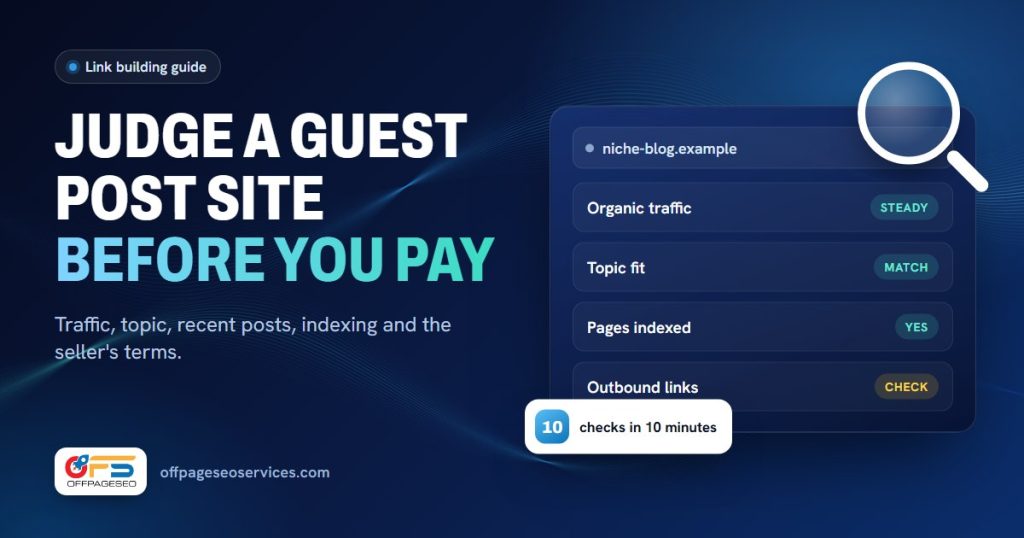
To judge a guest post site, check its organic search traffic first, then whether it covers your topic, what its recent posts look like, who else it links to, and whether its pages are indexed. Authority scores like DA and DR come last, because they are the easiest numbers to inflate. Ten minutes of checks can save you from paying for a link on a site nobody reads.
We sell guest posts, so run this checklist on any site before you pay, including ours.
Key takeaways
- Organic traffic beats authority scores. A DR 60 site with almost no search traffic is a red flag.
- Read the three newest posts. Thin articles stuffed with outbound links mean the site exists to sell links.
- A site that covers casino, health, crypto and home decor at once is not “in your niche”.
- Check that the site’s pages are indexed, and look at its history in the Wayback Machine.
- Get the terms in writing: dofollow, in the body, live URL, and what happens if the link disappears.
How do you check if a guest post site is good?
Run ten checks in this order: organic traffic, traffic trend, topic fit, recent posts, outbound links, indexing, domain history, people behind the site, authority scores, and the seller’s terms. The first five catch most bad sites. If a site fails traffic or topic fit, stop there. Nothing later in the list makes up for it.
- Organic traffic. Does it get visitors from search?
- Traffic trend. Is that traffic steady, or collapsing?
- Topic fit. Does the site cover your subject?
- Recent posts. Are the newest articles useful, or thin link carriers?
- Outbound links. Who else does the site link to?
- Indexing. Are its pages, including recent guest posts, in Google?
- Domain history. Was it always this site, or a recycled expired domain?
- People. Are there real authors, an about page and a contact route?
- Authority scores. Do DA and DR make sense next to the traffic?
- Seller terms. What exactly are you buying, and what if it goes wrong?
What traffic should a guest post site have?
There is no universal minimum, but the site should get real organic visitors from searches related to its topic, and the trend should be stable. Check in Ahrefs or Semrush. Our own floor is Ahrefs traffic of 5k+. More important than the number is where it comes from: keywords that match the site’s subject.
Three things to look at in the traffic report:
- The trend over 12 months. A sharp drop can mean a Google penalty or an update that hit the site. Paying for a link on a falling site means paying for yesterday’s value.
- The keywords. A pets blog getting its traffic from “online casino bonus” has been hacked, sold or repurposed.
- The countries. If you sell in the US and the site’s traffic is almost all from somewhere else, the referral value is low, even if the SEO value holds.
Does DA or DR matter more?
Neither matters as much as traffic and relevance. DA is a Moz score and DR is an Ahrefs score; Google uses neither. Both are estimates built from backlinks, and both can be pushed up with cheap links. Use them as a sanity check: a high score with little search traffic is a warning sign, not a bargain.
Our view after building links since 2016: when DR and traffic disagree, believe the traffic. That’s why our guest post sites need both DA and DR 30+ and Ahrefs traffic of 5k+, not one or the other.
What should you look for in the site’s recent posts?
Open the three newest posts. Good signs: articles written for readers, on the site’s own topic, with few outbound links that fit the text. Bad signs: short generic articles, one or two commercial links in each, unrelated topics from one post to the next, and a “sponsored” label on almost everything.
Read at least one of them properly. If you wouldn’t want your brand next to that article, don’t pay to be in the next one.
How do you spot a link farm or PBN sold as a guest post?
A link farm publishes anything for anyone. Look for posts on unrelated topics side by side, several outbound links per article to unrelated businesses, “write for us” banners across the site, no named authors, and traffic that doesn’t match the content. One of these can be innocent. Three together usually mean the site exists to sell links.
Google’s spam policies describe this pattern directly. They list “creating low-value content primarily for the purposes of manipulating linking and ranking signals” as link spam, along with “links with optimized anchor text in articles, guest posts, or press releases distributed on other sites” (Google: Spam policies). A link from that kind of site carries the most risk and the least value.
We cover how PBN links differ from guest posts and niche edits in guest post vs niche edit vs PBN.
How do you check that a site’s pages are indexed?
Search Google for site: followed by the domain, for example site:example.com. The result count is rough, but a site with hundreds of posts and only a handful of indexed pages has a problem. Then search the exact title of one recent guest post. If Google can’t find it, your post may not be found either.
An unindexed page passes nothing. This check takes a minute and catches sites that look fine in tools but that Google has stopped trusting.
How do you check a domain’s history?
Look the domain up in the Wayback Machine at web.archive.org. If it was a dental clinic three years ago and is now a “general news” blog, it is probably an expired domain bought for its old backlinks. Those sites often look strong in tools and carry little real trust.
A site that has covered the same subject for years, under the same name, is the pattern you want.
What should a guest post seller tell you before you pay?
Before paying, you should know: the site’s traffic and topic, who writes the article and how long it is, whether the link is dofollow and inside the article body, when it goes live, whether it stays up, and what happens if it’s late or removed. Get those answers in writing, even in a chat message.
For our own services:
- Guest posts: 500+ word article on a DA and DR 30+ site with Ahrefs traffic of 5k+, contextual dofollow link, live in 5 to 7 days, permanent. Full refund within 12 to 24 hours if we’re late. The report gives you the live URL and site metrics, so you can run every check in this post on what you received.
- Niche edits: we send the articles we found, and nothing is placed until you approve them. You can run this checklist before you say yes.
A seller who won’t answer these questions has told you what you need to know.
A seller offers a DA 60 guest post for $20. Is it real?
Maybe, but check before paying. Look up the site’s organic traffic, the keywords it ranks for and its last three posts. A cheap high-DA offer is often a site with inflated scores and little search traffic, selling posts to anyone. If traffic and topic hold up, it may be a real find.
Price alone tells you little in either direction. Run the checklist and let the site answer for itself. For a wider view of when guest posts pay off, read is guest posting worth it.
Frequently asked questions
Which tools do I need to check a guest post site?
One SEO tool with traffic estimates, such as Ahrefs or Semrush, plus Google search and the Wayback Machine. Free versions show enough for a first look at traffic and top keywords.
Is a “write for us” page a bad sign?
Not on its own. Many real blogs accept contributors. It becomes a warning when the banner is on every page, the site accepts every topic, and most posts carry commercial links.
Should guest post sites be in my exact niche?
Close is enough. A site about digital marketing is a fit for an SEO tool; a site about gardening is not. What matters is that the article and your link make sense to that site’s readers.
How many outbound links per post is too many?
There is no fixed rule. Judge whether each link helps the reader. Several links per post to unrelated businesses is a sign the site sells links to anyone.
Want sites that pass these checks? Our guest posts run on DA and DR 30+ sites with Ahrefs traffic of 5k+, from $100, live in 5 to 7 days. See guest post packages, or try niche edits if you want to approve every site first. For the bigger picture, start with our guide to off-page SEO.