

Is Buying Backlinks Safe? Google’s Rules and the Real Risk

No, buying backlinks isn’t fully safe. Google’s spam policies list “buying or selling links for ranking purposes” as link spam. Often the result isn’t a ban: Google’s systems ignore the paid links, and you lose what you paid for. A manual action against your site is rarer, and more likely when the links are obvious. How risky a paid link is depends on where it sits, how it’s written and how many you buy.
We sell dofollow links, so we have a reason to tell you this is fine. We won’t. This guide covers what Google’s rules actually say, how paid links get found, what happens next, and what lowers the risk.
Key takeaways
- Paid links meant to pass ranking credit break Google’s spam policies. Paid links marked
rel="sponsored"orrel="nofollow"don’t. - Google finds link spam with automated systems, and since 2022 it can detect sites that buy links.
- A common outcome is that the links simply stop counting. A manual action is the worse outcome.
- Links on sites with real readers, in your topic, with natural anchors, carry the lowest risk.
- Buying a link breaks Google’s rules, not the law in most countries.
Is buying backlinks against Google’s rules?
Yes, if the link is meant to help your rankings. Google’s spam policies name “buying or selling links for ranking purposes” as link spam, and that includes “exchanging goods or services for links”. Buying a link is allowed when it’s marked with rel=”sponsored” or rel=”nofollow”, because then it passes no ranking credit.
Google’s spam policies define link spam as creating links “primarily for the purpose of manipulating search rankings”. The same page also says that “Google does understand that buying and selling links is a normal part of the economy of the web” for advertising, and that such links are fine when they carry the nofollow or sponsored attribute.
So the line isn’t between paid and free. It’s between links that are labelled as paid and links that pass ranking credit without the label. A dofollow guest post bought for SEO sits on the wrong side of that line, and that includes the ones we sell.
Is buying backlinks illegal?
In most countries, no. Buying a link breaks Google’s rules, which are a search engine’s terms, not a law. Advertising law is a separate question: some countries require paid content that promotes a product to be disclosed. If your business is regulated, ask a lawyer before you buy any sponsored content.
The practical risk is to your search traffic, not a fine. That’s the risk the rest of this guide is about.
Can Google tell if a link is paid?
Often, yes. Google detects spam through automated systems and, when needed, human review. In its December 2022 link spam update, Google said its AI system SpamBrain “can now detect both sites buying links, and sites used for the purpose of passing outgoing links.” Sites that sell links to anyone are the easiest to catch.
That quote is from Google’s announcement of the December 2022 link spam update. Google doesn’t publish its signals. These are the patterns that make a paid link easy to spot, for an algorithm or a person:
- The site has a public “write for us” price list and links out to every topic.
- Posts are marked “sponsored” or “guest post” but the links are dofollow.
- The article has nothing to do with the rest of the site.
- The anchor text is an exact keyword, like “best cheap car insurance”.
- The site has a high authority score but no search traffic of its own.
- Your site suddenly gains many links of the same kind in a few weeks.
What happens if Google finds paid links?
Usually the links are ignored, so whatever they did for your rankings disappears. In worse cases, a Google reviewer issues a manual action for unnatural links, which can push some or all of your site out of search results until you clean up and request a review.
| Outcome | What it means | What you can do |
|---|---|---|
| Links neutralized | Google said “spammy links are neutralized and any credit passed by these unnatural links are lost.” Rankings the links gave you can drop. | Nothing to fix. Build links that count instead. |
| Algorithmic demotion | Google’s policies say sites that break them “may rank lower in results or not appear in results at all.” | Stop the spam, improve the site and wait. Recovery can take months. |
| Manual action | A reviewer finds “a pattern of unnatural, artificial, deceptive, or manipulative links” to your site. You get a message in Search Console. | Remove or disavow the links, then select Request Review in the Manual Actions report. |
The manual action wording and the review steps are on Google’s Manual Actions report help page. Google warns there that disavowing every backlink without trying to remove them “might lead to rejection of your request.”
How risky is each type of paid link?
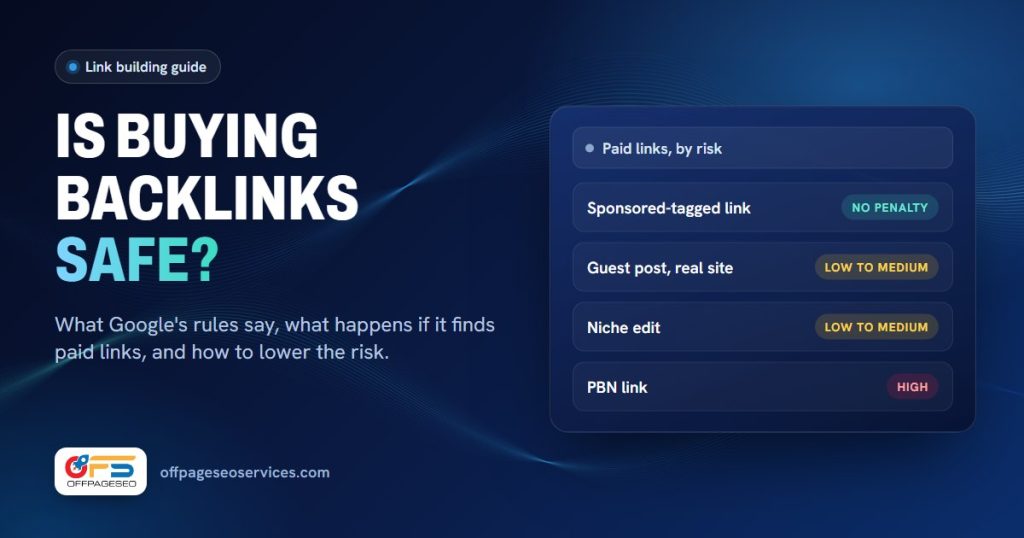
Risk follows how obvious the link is. A link marked sponsored carries no penalty risk and no ranking credit. Guest posts and niche edits on real sites in your topic carry low to medium risk. PBN links and links from sites that sell to everyone carry the highest risk.
| Link type | Penalty risk | Why |
|---|---|---|
| Paid link marked sponsored or nofollow | None | Allowed by Google’s policies. It passes no ranking credit, so it helps only with traffic and brand. |
| Press release on a news site | Low | The links are usually nofollow. The value is the mention, not the link. |
| Guest post on a real site in your topic | Low to medium | Looks like normal editorial content when the site has readers and the anchor is natural. |
| Niche edit in an existing article | Low to medium | Same as a guest post, if the article and the site are relevant to your page. |
| Blog comments | Low to medium | Low with a name or brand anchor. Google’s policy lists forum comments with optimized links as an example, and keyword-stuffed blog comments look the same. |
| PBN links | High | The sites exist to pass links, which is exactly what SpamBrain was trained to find. |
We compare price, speed and risk for the three main types in guest post vs niche edit vs PBN. We sell PBN links too, and our own page says they’re higher risk.
How do you lower the risk of paid links?
Buy fewer, better links. Choose sites with real search traffic in your topic, use your brand or a natural phrase as the anchor, spread links over weeks, and avoid sites that sell links to anyone. Keep earning some links for free, so paid links are never the whole profile.
- Check the site’s traffic yourself. Put it into Ahrefs or Semrush and look for steady organic traffic from keywords in its own topic. Our checklist is in how to judge a guest post site before you pay.
- Stay in your topic. A link from a site about your subject looks like a recommendation. A link from a site about everything looks like an ad.
- Use natural anchors. Your brand name, your URL or a phrase that reads normally in the sentence. Save exact keywords for a small share of links.
- Keep a steady pace. A few links a month look like growth. Fifty in a week look like a purchase.
- Skip sitewide and footer links. Links repeated across every page of a site are another example on Google’s list.
- Make the page worth linking to. A strong page attracts links you didn’t pay for, and those make the paid ones look normal.
Cheap links are often the expensive ones. A $10 pack of PBN links that Google neutralizes gives you nothing back. One $100 guest post on a site with real readers costs ten times as much and is far more likely to still count a year later.
When shouldn’t you buy backlinks at all?
Don’t buy dofollow links if losing your Google traffic would sink the business, if your site already has a manual action, or if your page isn’t ready to rank. Links can’t fix a weak page. And if you need zero risk, buy only sponsored-tagged placements and accept they won’t pass ranking credit.
That includes buying from us. Don’t order from us if:
- You can’t afford any risk to your search traffic. We sell dofollow links, and no dofollow paid link is risk-free.
- Your site has a manual action now. Clean it up and get it lifted first.
- Your page is thin. Fix the content first. We’ll tell you if we think it needs work before links will help.
- You want a written guarantee of no penalty. Nobody can give one honestly.
If you’re weighing the cost against the risk, our breakdown of what SEO and backlinks cost shows the market prices next to ours.
Frequently asked questions
Will my site be penalized if I buy guest posts?
It can be, but a penalty is the less common outcome. More often Google ignores links it sees as paid. A manual action becomes more likely with many links from sites that sell to anyone, exact-match anchors and a sudden spike in links.
Can Google tell if a link is paid?
Often. Google uses automated systems and human review, and says its SpamBrain system can detect both sites buying links and sites set up to pass links. Links on sites with real readers, in your topic, are the hardest to tell apart from editorial links.
Is buying backlinks illegal?
In most countries, no. It breaks Google’s spam policies, not the law. Some countries have advertising rules that require paid promotion to be disclosed, so check with a lawyer if your business is regulated.
Are paid links with rel=”sponsored” useless?
Not useless, but they don’t pass ranking credit. They can still send visitors and get your brand in front of new readers, with no penalty risk.
How do I lower the risk of buying links?
Buy fewer links on sites with real search traffic in your topic, use brand or natural anchors, spread them over weeks, and keep earning free links alongside them.
Want to see our sites before you decide? Ask for sample sites in your niche on WhatsApp. Check their traffic yourself, and order only if they pass. Niche guest posts start at $100 and go live in 5 to 7 days.