

What Is SEO? How It Works in Google and AI Search (2026)

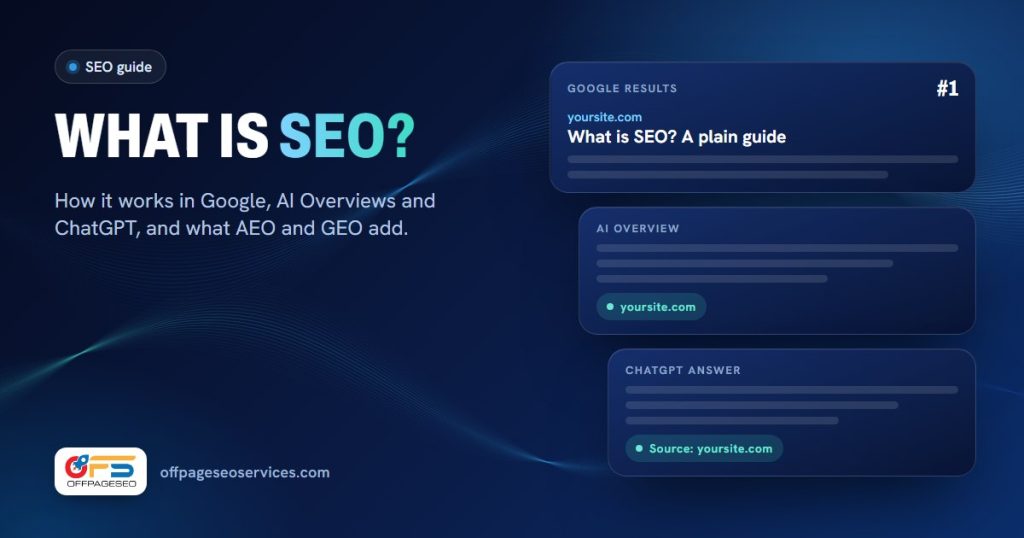
SEO (search engine optimization) is the work of making your pages easy for search engines to find, understand and trust, so they show them to people searching for what you offer. In 2026 that includes AI answers. Google’s AI Overviews, ChatGPT search and Perplexity build their answers from web pages, and the same SEO work decides whether yours is one of them.
We’re a link building agency, so we sell one part of SEO: getting other sites to link to yours. This guide covers all of it, including the parts we don’t sell. It also says plainly where AEO and GEO are new, and where they are SEO with a new name.
Key takeaways
- SEO has four parts: on-page (your content), technical (whether search engines can crawl and index you), off-page (links and mentions from other sites) and local.
- Google works in three stages: crawling, indexing and serving results. A page that isn’t indexed can’t rank, in regular results or in AI Overviews.
- AEO (answer engine optimization) aims to make your content the direct answer. GEO (generative engine optimization) aims to get your brand named or cited inside answers that AI tools write.
- Google says there are “no additional requirements to appear in AI Overviews or AI Mode”. Good SEO is still the base for AI search.
- ChatGPT and Perplexity use their own search crawlers. If your robots.txt blocks them, your pages can’t show up in their search answers.
- SEO is slow. Google says some changes take effect “in a few hours, others could take several months.”
What is SEO?
SEO, short for search engine optimization, means improving your website so search engines can find it, understand it and show it for the searches your customers make. It covers what’s on your pages, how your site is built and what other sites say about you. The visits it brings are called organic traffic, because you don’t pay for each click.
Google’s own SEO Starter Guide puts it this way: “SEO—short for search engine optimization—is about helping search engines understand your content, and helping users find your site and make a decision about whether they should visit your site through a search engine.”
That last part matters. Ranking isn’t the finish line. Your title and description have to convince someone to click, and your page has to give them what they came for.
SEO vs paid search
Search results have two kinds of listings. Ads are marked Sponsored, you pay for every click, and they disappear the day you stop paying. That’s paid search, often called SEM or PPC. Everything else is organic. You can’t buy those positions: Google says it “doesn’t accept payment to rank pages higher, and ranking is done programmatically.” SEO is how you earn them.
Paid search is fast and stops when the budget stops. SEO is slow and keeps working after the work is done. Most businesses that rely on search use both for a while, then lean on SEO as it starts to pay back.
How does Google Search work?
Google works in three stages. Crawlers download pages they find, mostly by following links. Indexing stores what each page is about in Google’s database. Serving picks the most relevant indexed pages for each search. A page has to get through all three stages to rank, and Google says not every page does.
Google’s guide to how Search works describes the stages in these words:
- Crawling: “Google downloads text, images, and videos from pages it found on the internet with automated programs called crawlers.”
- Indexing: “Google analyzes the text, images, and video files on the page, and stores the information in the Google index, which is a large database.”
- Serving search results: “When a user searches on Google, Google returns information that’s relevant to the user’s query.”
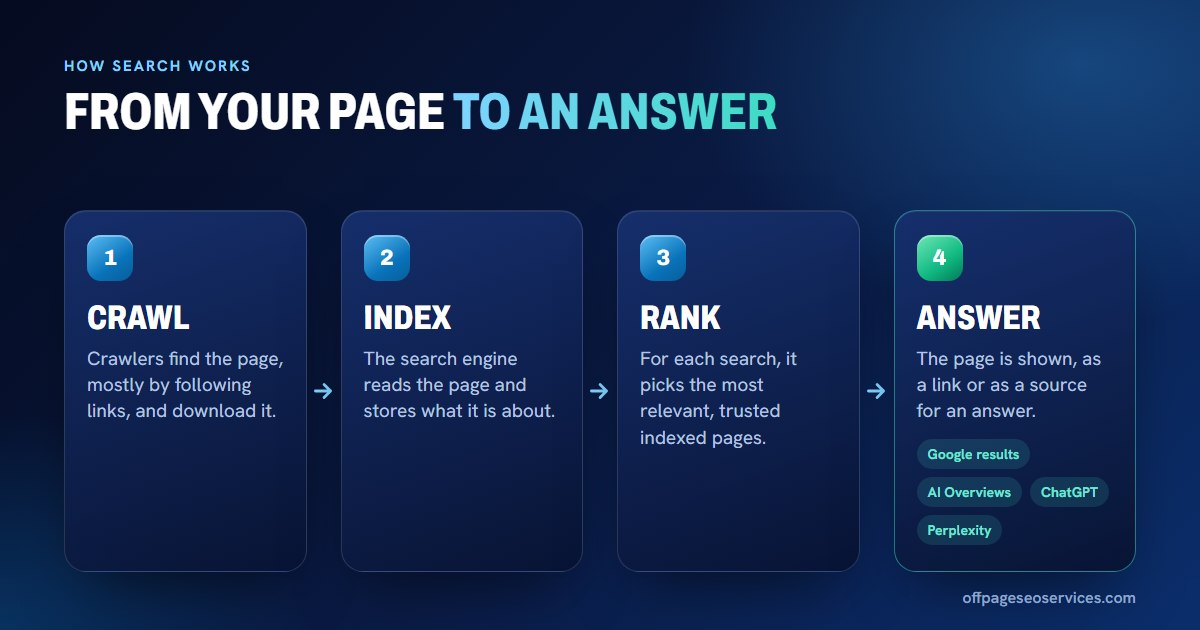
Each stage gives you a job:
- Help Google find the page. Link to it from your other pages, add it to your XML sitemap, and get other sites to link to it. Crawlers find most new pages through links.
- Make the page worth indexing. Google lists low-quality content and a robots meta rule that blocks indexing among the common reasons a page doesn’t get in. Write something that isn’t already on a thousand other pages.
- Make it the best match for the search. Answer the question the searcher typed, on a page that loads fast and works on a phone. Links from other relevant sites tell Google the page is trusted.
Gary Illyes from the Google Search team explains the same pipeline in this short video:
What are the types of SEO?
There are four main types. On-page SEO is your content, titles and headings. Technical SEO makes sure search engines can crawl, render and index your site. Off-page SEO is what other sites say about you, mostly links and mentions. Local SEO helps a business show up in map results for nearby searches.
| Type | What it covers | Examples |
|---|---|---|
| On-page SEO | The content of each page and how it’s labelled | Answering the search question, title tags, headings, internal links, image alt text |
| Technical SEO | Whether search engines can reach and read the site | Crawlability, indexing, site speed, mobile layout, HTTPS, structured data, XML sitemap |
| Off-page SEO | Signals from outside your site | Backlinks, brand mentions, guest posts, digital PR, reviews |
| Local SEO | Visibility for searches near a place | Google Business Profile, local citations, reviews, location pages |
The four depend on each other. A strong article on a page Google can’t index gets no traffic. A technically perfect site with thin content has nothing to rank. And links pointing at a weak page mostly go to waste. We cover the outside part in detail in our guide to off-page SEO, because that’s the part we do every day.
Is SEO dead because of AI?
No. AI answers are written from web pages, and the pages they draw on are the ones search engines can crawl, index and trust. What has changed is the reward. When the answer sits at the top of the results, some people never click, so being the source the answer uses now matters as much as ranking in position one.
Google says this directly in its guide to AI features and your website: “The best practices for SEO remain relevant for AI features in Google Search (such as AI Overviews and AI Mode). There are no additional requirements to appear in AI Overviews or AI Mode, nor other special optimizations necessary.”
The same page sets the bar for being shown as a link in an AI answer: “a page must be indexed and eligible to be shown in Google Search with a snippet”. In other words, the ticket into Google’s AI answers is the same ticket into its regular results.
Our view: most of what is sold as GEO today is good SEO under a new name. Clear answers, real expertise, a site Google can index and other sites that mention you were the job before AI, and they’re the job now. The part that is genuinely new is measuring it, because an AI answer doesn’t show up in a rank tracker the way a list of ten links did.
What are AEO and GEO?
AEO, answer engine optimization, means writing and structuring content so a search engine or assistant can lift it as the direct answer: a featured snippet, a voice answer or an AI Overview. GEO, generative engine optimization, means getting your brand mentioned and cited inside answers that AI tools write, such as ChatGPT, Perplexity, Gemini and Google AI Mode.
The names overlap, and people use them loosely. You’ll also see AI SEO, LLM SEO and LLMO for roughly the same idea. One warning: “GEO” is also used for geo-targeting, meaning local SEO for a city or region. When someone offers you GEO, ask which one they mean. In this guide, GEO always means generative engine optimization.
AEO in practice
AEO is about the shape of your content. Search engines and assistants look for a passage that answers a question completely and can stand on its own. So you:
- Use the searcher’s question as a heading, the way this guide does.
- Answer it in the first 40 to 60 words under that heading, then add detail.
- Use lists for steps, tables for comparisons, and plain sentences for definitions.
- Add FAQ sections with structured data where they help the reader.
GEO in practice
GEO is about being part of the source material when an AI tool writes an answer about your topic. That depends on things AI tools can see across the web, not only on your own page:
- Your pages can be crawled by the AI tools’ search crawlers.
- Your content states facts clearly, with numbers and sources, so it can be quoted accurately.
- Other trusted sites in your topic mention your brand and link to you.
- Your brand name, what you do and who is behind it are consistent everywhere.
SEO vs AEO vs GEO: what’s the difference?
They share one base and aim at different finish lines. SEO aims for a ranked link that people click. AEO aims for your content to be the answer shown on the results page. GEO aims for your brand to be named or cited inside an AI-written answer. You don’t pick one: AEO and GEO only work on top of solid SEO.
| SEO | AEO | GEO | |
|---|---|---|---|
| Goal | Rank a page and earn the click | Be the direct answer | Be named or cited in an AI answer |
| Where you show up | Organic results in Google and Bing | Featured snippets, People Also Ask, voice answers, AI Overviews | ChatGPT, Perplexity, Gemini, Google AI Mode and AI Overviews |
| What helps most | Relevant content, a crawlable site, links from other sites | Question headings, short complete answers, lists, tables, FAQ markup | Clear facts with sources, mentions and links on trusted sites, access for AI crawlers |
| How you measure it | Rankings, clicks and impressions in Search Console | Snippets and answer boxes you hold for your target questions | How often AI tools name or link you, and referral visits from AI tools |
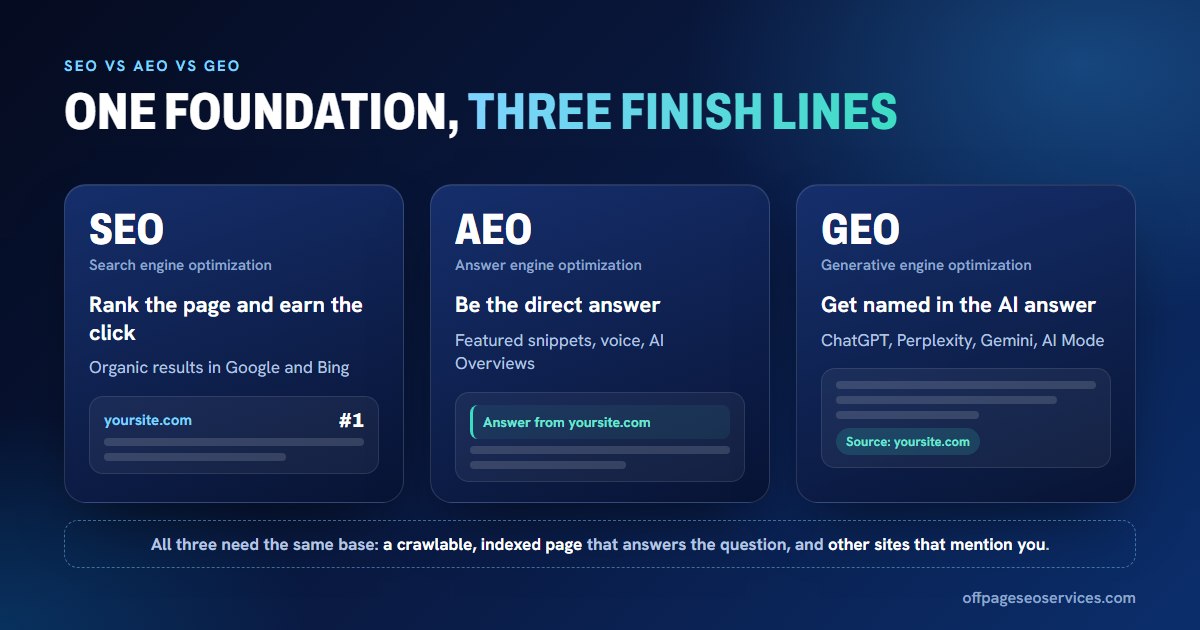
The order matters. Start with SEO, because a page that isn’t indexed can’t be an answer or a citation. Then shape your best pages for AEO, which costs little once the content exists. Work on GEO last, because the biggest GEO lever, being mentioned on other sites, takes the longest.
How do you show up in AI Overviews, ChatGPT and Perplexity?
Get your page indexed, let the AI search crawlers in, answer questions plainly near the top of each section, and get mentioned on other trusted sites in your topic. Google says AI Overviews need nothing beyond normal SEO. ChatGPT and Perplexity need their own search crawlers allowed in your robots.txt.
- Check the page is indexed. Use the URL Inspection tool in Google Search Console. If Google hasn’t indexed it, it can’t appear in AI Overviews or AI Mode.
- Let the AI search crawlers in. OpenAI says “OAI-SearchBot is used to surface websites in search results in ChatGPT’s search features”, and that “Sites that are opted out of OAI-SearchBot will not be shown in ChatGPT search answers” (OpenAI crawler documentation). Perplexity says “PerplexityBot is designed to surface and link websites in search results on Perplexity” (Perplexity crawler documentation). Check that your robots.txt, firewall or CDN doesn’t block them. Training crawlers such as GPTBot are separate, so you can block training and still allow search.
- Put the answer first. Under each question heading, answer in 40 to 60 words before you add detail. Long build-ups make your page harder to quote.
- Make facts easy to lift. Exact numbers, named sources, dates and author names. A sentence that contains the whole fact can be quoted without the paragraph around it.
- Get mentioned where your buyers read. An AI tool can only name brands that appear in the pages it reads. Links and mentions on real sites in your topic do double duty: they help your Google rankings and give AI tools more pages that connect your brand to your subject.
- Keep pages current. Update numbers, prices and dates when they change, and show the updated date. Stale numbers make a page less useful to quote, for people and for AI tools.
For a walkthrough of the Google side, Ahrefs has a short tutorial on ranking in AI Overviews:
Two things to skip. Don’t rewrite your pages to repeat “AI” keywords, because AI tools look for answers, not for the word AI. And be wary of anyone who promises that ChatGPT will recommend you. Nobody controls what an AI tool writes, and Google says on its AI features page that meeting every requirement doesn’t guarantee a page will be shown.
How long does SEO take?
Usually months, not days. Google says some changes “might take effect in a few hours, others could take several months,” and suggests waiting “a few weeks to assess” whether a change helped. New sites take longer than established ones, and competitive searches take longer than niche ones.
Those quotes come from the same SEO Starter Guide, which also says plainly: “There are no secrets here that’ll automatically rank your site first in Google (sorry!).” Anyone who promises first place in a week is selling something else.
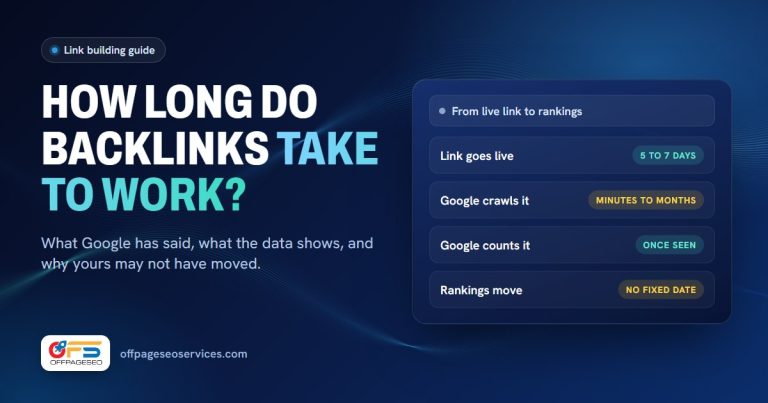
Links follow the same slow pattern: Google has to crawl the page that links to you before the link counts. We go through the timeline in how long backlinks take to work.
How do you measure SEO and AI search visibility?
Measure SEO in Google Search Console: clicks, impressions, average position and which pages are indexed. Measure AI visibility in two ways: referral visits from AI tools in your analytics, and regular manual checks of what ChatGPT, Perplexity and Google say when asked the questions your customers ask.
- Search Console: the queries you appear for, your clicks and impressions, and indexing errors. It’s free and it’s Google’s own data.
- Analytics referrals: visits from chatgpt.com, perplexity.ai and gemini.google.com show up as referral traffic. Track them as their own channel.
- Manual prompt checks: keep a list of 10 to 20 questions a buyer would ask, ask them in each AI tool every month, and note whether you’re named or linked.
- Brand mentions: count how many sites in your topic mention you, with or without a link, and watch whether the number grows month to month.
Can you do SEO yourself?
Yes, most of it. On-page and basic technical SEO need time and care more than tools, and Google’s Starter Guide is free. Off-page SEO is the hardest part to do alone, because it depends on other site owners agreeing to mention or link to you. That’s the part most businesses pay for.
A sensible split for a small business: write and fix your own pages, set up Search Console, and get help with links once your pages are worth linking to. If you’re comparing costs, our breakdown of SEO and link building prices shows market prices next to ours.
When shouldn’t you hire us?
Don’t hire us if your pages aren’t indexed yet, if your site has only a few thin pages, if you need local or technical SEO, or if you can’t accept any risk from paid links. We build links and mentions. They help pages that are already good, and they can’t fix the rest.
- Your pages aren’t indexed. Links to a page Google won’t index do nothing. Fix that first in Search Console.
- Your site is new and thin. Five short pages don’t need links yet. They need content that answers real questions.
- You need technical or local SEO. We don’t run technical audits or manage Google Business Profiles. Hire a specialist for that.
- You can’t accept any risk. We sell dofollow links, and no paid dofollow link is risk-free. We explain why in is buying backlinks safe.
- You want a guaranteed AI mention. Nobody can promise what ChatGPT or Google’s AI will write. We won’t.
Frequently asked questions
Is SEO dead because of AI?
No. AI answers in Google, ChatGPT and Perplexity are built from web pages that search engines can crawl and index. Google says SEO best practices remain relevant for AI Overviews and AI Mode, with no additional requirements. What changed is that being quoted in the answer now matters as much as ranking first.
What is the difference between AEO and SEO?
SEO aims to rank a page and earn the click. AEO aims to make your content the answer itself, in a featured snippet, a voice answer or an AI Overview. AEO is built on SEO: a page has to be indexed and ranking well before it’s likely to be chosen as the answer.
What is GEO in SEO?
GEO usually means generative engine optimization: getting your brand mentioned and cited in answers written by AI tools like ChatGPT, Perplexity and Gemini. Some people also use GEO to mean geo-targeted local SEO, so ask which one is meant before you buy it.
How do I rank in ChatGPT?
Allow OpenAI’s search crawler, OAI-SearchBot, in your robots.txt, because OpenAI says sites that opt out of it won’t be shown in ChatGPT search answers. Then answer questions clearly on your pages, and get mentioned on other trusted sites in your topic. Nobody can guarantee ChatGPT will name you.
How long does SEO take to work?
Usually several months. Google says some changes take effect in a few hours and others take several months, and suggests waiting a few weeks before judging a change. New sites and competitive searches take longer.
Do backlinks still matter for AI search?
Yes. Google’s AI features link to pages from its Search index, and links still help pages rank there. Links and mentions on relevant sites also give AI tools more sources that connect your brand to your topic.
Want other sites in your topic to mention you? Browse our link insertion sites with their DA, DR, traffic and price on every row, from $25 a link. Or message us on WhatsApp with your URL and we’ll suggest sites in your niche before you pay.