

Free Backlinks: Which Still Work and Which Waste Time

Yes, you can get backlinks for free, but the free links that help rankings cost you time instead of money. Free guest posts, brand mentions, resource pages and links from people you already work with can pass real value. Profile links, web 2.0 blogs, blog comments and directories are mostly nofollow or low value: useful for brand presence and variety, not for pushing a page up the rankings.
We build links for a living, and our off-page packages include web 2.0, forum and comment links. So we know what each free type is good for, and where people waste weekends on links that do nothing. This page sorts them.
Key takeaways
- The free links that move rankings are earned: guest posts you write, mentions you claim, resources you get listed on.
- Profiles, web 2.0 blogs, comments and forums are mostly nofollow. Use them for brand presence and link variety.
- Google’s spam policies name low-quality directory and bookmark links, and forum links with optimized anchors, as link spam.
- Check each link type and site before you spend time on it. A list from 2019 is mostly dead sites.
- If your time costs more than the link, a paid link on a real site is often the cheaper option.
Can you get backlinks for free?
Yes. Free backlinks come from writing guest posts for sites that accept them, getting listed on resource pages, claiming unlinked mentions of your brand, and creating profiles, blogs and comments on platforms that allow links. The first group can help rankings. The second group mostly gives nofollow links that help brand presence more than rankings.
“Free” means no payment to the site. It doesn’t mean no cost. A free guest post can take several hours of pitching and writing. Fifty profile links can take a full day. Count your time before you decide what’s cheap.
Which free backlinks are worth it?
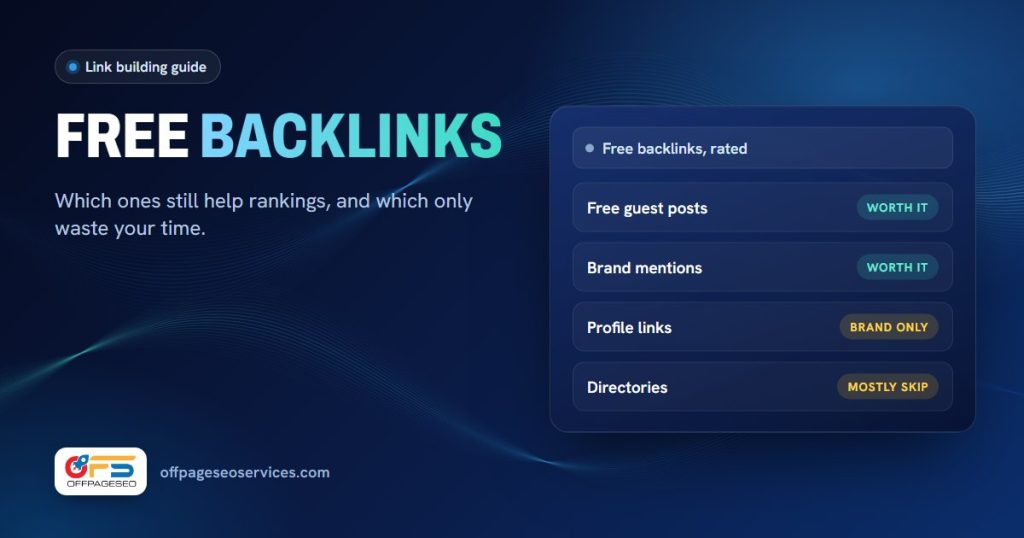
Free guest posts, unlinked brand mentions, resource page listings and links from partners and suppliers are worth the effort, because they come from real sites with real readers. Profile links and web 2.0 blogs are worth a little time for brand presence. Blog comments, forums, directories and bookmarking sites are mostly not worth it for rankings.
| Free link type | Usual link type | Effort | Helps rankings? |
|---|---|---|---|
| Free guest posts | Often dofollow | High | Yes, on a relevant site with traffic |
| Unlinked brand mentions | Dofollow if the editor agrees | Low | Yes |
| Resource pages | Often dofollow | Medium | Yes, if the page is maintained |
| Partners, suppliers, clients | Varies | Low | Some, and they’re relevant |
| Profile links | Mostly nofollow | Low | Little. Brand presence |
| Web 2.0 blogs | Varies by platform | Medium | Little on their own |
| Blog comments | Mostly nofollow | Low | Little. Traffic if the post is read |
| Forums and Q&A | Mostly nofollow | Medium | Little. Traffic if your answer is good |
| Directories and bookmarking | Varies | Low | Mostly no. Low-quality ones are link spam |
The free backlinks that can help rankings
Free guest posts
Many blogs accept guest posts for free if the article is useful to their readers. Search for your topic plus “write for us” or “guest post guidelines”, read the rules, and pitch one specific idea. The link is usually in the author bio or the article, and on a relevant site with traffic it’s one of the strongest free links you can get.
Before you write for a site, check that it has organic traffic from Google and covers your topic. A free post on a site nobody reads is time you won’t get back. Our checklist for that is in how to judge a guest post site before you pay, and it works the same when you’re not paying.
Unlinked brand mentions
Search for your brand name and see which sites mention you without a link. Email the author or editor, thank them for the mention, and ask if they’d add a link. It’s the easiest free link there is, because they already chose to write about you. Set a free Google Alert for your brand so you catch new mentions.
Resource pages
Many sites keep pages like “useful tools” or “resources for small businesses”. If you have a page that genuinely fits, a guide, a calculator, a template, ask to be added. Pages that were last updated years ago rarely reply. Pick ones that still get edited.
Partners, suppliers and clients
Businesses you buy from, sell to or work with often have partner pages, case studies or testimonial sections. A testimonial with a link back, or a “where to buy” listing, is relevant and free. Google’s spam policies warn against link exchanges done “exclusively for the sake of cross-linking”, so keep it to real relationships.
The free backlinks that mostly don’t help rankings
Profile links
Profile links come from creating an account on a site, a forum, a social network, a design or developer platform, and adding your website to the profile. Most are nofollow and sit on pages nobody visits. They help people and search engines connect your brand across the web, but they won’t push a page up the rankings on their own.
Create the ones that make sense for your business, fill them in properly, and stop there. A complete profile on ten platforms your customers use beats a thin one on two hundred.
Web 2.0 blogs
Web 2.0 links come from free blogs you set up on hosted platforms, such as Blogger, WordPress.com, Medium or Tumblr, with a post that links to your site. Whether the link is followed depends on the platform. On their own they carry little weight, because a new blog on a subdomain has no authority of its own. Link builders mostly use them as tier 2 support: links that point at your stronger links, not at your money page.
Blog comments
WordPress, which runs a large share of blogs, marks comment links as nofollow by default, and Google recommends marking comment links with rel="ugc" (Google: Qualify outbound links). A thoughtful comment on a popular post can still bring a few visitors. Dropping links in comments for rankings doesn’t work. Our view on where comments fit is on the niche blog comments page.
Forums and Q&A sites
Answering questions on forums and Q&A sites can bring real visitors if your answer is the best one in the thread. The links are mostly nofollow. Google’s spam policies list “Forum comments with optimized links in the post or signature” as link spam, so link only when it answers the question, and never with a keyword anchor in your signature.
Directories and bookmarking sites
A few directories still matter: your industry’s main associations, local business listings if you serve a city, and the platforms your customers search. Mass submissions to general directories and bookmarking sites don’t. Google’s spam policies name “Low-quality directory or bookmark site links” as link spam (Google: Spam policies).
Are free backlinks safe?
Free links you earn, such as guest posts, mentions and resource listings, are as safe as any link. Free links built in bulk are not. Google’s spam policies count automated links, low-quality directory and bookmark links, and forum links with optimized anchors as link spam. The risk comes from volume and anchors, not from the price.
If a free link is one you’d be embarrassed to show a Google reviewer, it isn’t free. It’s a debt. What keeps free link building safe:
- Brand name or URL anchors on profiles, comments and forums, never keyword anchors.
- No software that creates accounts or posts for you. Google lists “Using automated programs or services to create links to your site” as link spam.
- A pace that matches your real activity, not 300 profiles in a weekend.
How do you check if a free backlink is dofollow?
Open the page with your link, right-click the link and choose Inspect. If the link’s code includes rel=”nofollow”, rel=”ugc” or rel=”sponsored”, it’s not a followed link. If it has none of those, it’s dofollow. Check after the link goes live, because many sites add nofollow automatically.
To see which links Google has found for your site, use the Links report in Google Search Console. It’s free and it shows your top linking sites. We explain the difference between the link types in more detail in our off-page SEO guide.
When should you pay for links instead?
Pay when your time costs more than the link. If a free guest post takes six hours of pitching and writing, and a paid one on a similar site costs less than six hours of your time, paying is the cheaper option. Also pay when you need links from sites in your niche that don’t accept free contributions.
For comparison, our general guest posts start at $10 with 2 dofollow links, and niche guest posts start at $100. Our off-page SEO packages include web 2.0, forum and blog comment links built by hand, for anyone who wants the support links without spending the weekend on them.
And when not to pay anyone, us included: if your page is thin or doesn’t answer the search, fix the page first. No link, free or paid, holds a ranking for a page that doesn’t deserve it.
Frequently asked questions
What are the best free backlink sites?
The best free links come from sites in your topic that have their own search traffic: blogs that accept guest posts, resource pages that are still maintained, and sites that already mention your brand. Large platforms where you can create a profile are useful for brand presence, but most of those links are nofollow.
Do free backlinks still work in 2026?
Earned free links still work: guest posts, brand mentions and resource listings. Bulk free links from profiles, directories, comments and bookmarking sites mostly don’t help rankings, and low-quality ones count as link spam under Google’s policies.
Are nofollow backlinks useless?
No. Nofollow links can bring visitors, help people find your brand, and make your link profile look natural. They just don’t pass ranking credit the way followed links do.
How many free backlinks should I build?
There’s no useful number. Ten links from relevant sites with traffic do more than a thousand from sites nobody reads. Build the free links that make sense for your business, and spend the rest of the time on your content.
No time to build them yourself? General guest posts start at $10 with 2 dofollow links, and our off-page packages include hand-built web 2.0, forum and comment links. Ask on WhatsApp, or compare all link building services.