

Off-Page SEO: What It Is and What Actually Moves Rankings

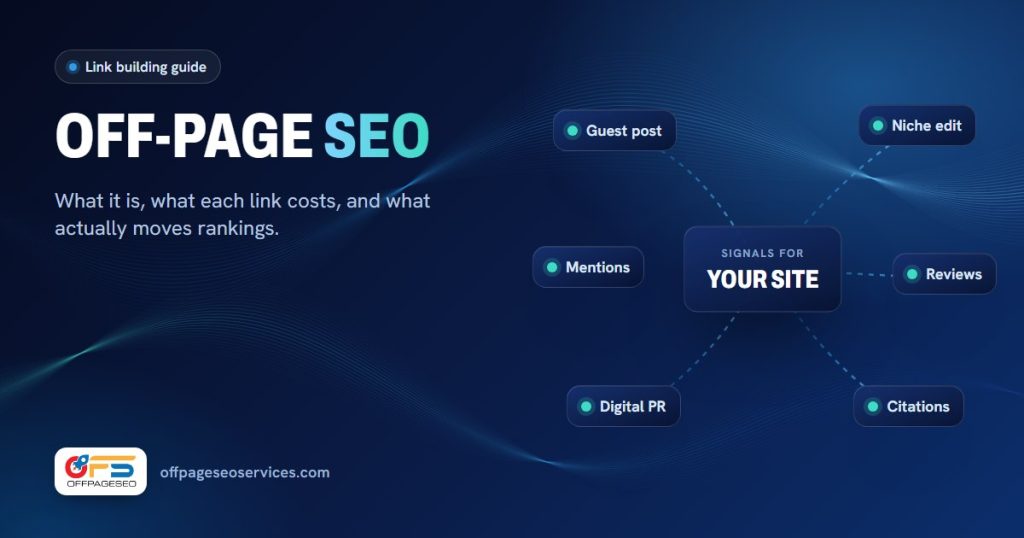
Off-page SEO is the work done outside your website that tells search engines your pages deserve to rank. In practice it is mostly backlinks: links from other websites to yours, which Google uses as a signal of relevance. Brand mentions, reviews and PR help too, but links do most of the work, and they are where most of the money and the risk sit.
This guide covers what counts as off-page SEO, which activities matter, what each type of link costs and risks, and when off-page SEO is the wrong fix for your site.
Key takeaways
- Off-page SEO means signals from other sites: links first, then mentions, reviews and PR.
- Fix the page before you build links to it. A link to a thin or unindexed page is wasted.
- Paid links that pass ranking credit break Google’s spam policies. Relevant sites, real traffic and natural anchor text keep the risk lower, but never at zero.
- Guest posts and niche edits are the steady options. PBN links are fast and risky. Blog comments and Wikipedia citations are support, not the main course.
- You can start with a single $100 guest post to your best page and judge the result before spending more.
What is off-page SEO?
Off-page SEO is everything that happens on other websites to improve how your site ranks. The main part is earning or building backlinks from relevant sites. It also covers brand mentions, reviews, digital PR and community activity. On-page SEO is what you change on your own pages; off-page SEO is how the rest of the web vouches for them.
The common off-page activities are:
- Link building: guest posts, niche edits, digital PR, resource and broken-link outreach.
- Brand mentions: your name on news sites, blogs and podcasts, with or without a link.
- Reviews and profiles: Google Business Profile, Trustpilot, industry directories.
- Community activity: useful answers on Reddit, Quora and niche forums.
- Social sharing: it helps people find your content, which is how some links start.
What is the difference between on-page and off-page SEO?
On-page SEO is the work you do on your own pages: content, titles, headings, internal links, speed and structure. Off-page SEO is the reputation your site earns elsewhere, mostly through links and mentions. On-page decides what a page is about and whether it deserves to rank; off-page decides how much trust it gets compared with competing pages.
| On-page SEO | Off-page SEO | |
|---|---|---|
| Where it happens | Your own website | Other websites |
| Who controls it | You, fully | Site owners, editors, journalists |
| Main work | Content, titles, headings, speed, internal links | Backlinks, mentions, reviews, PR |
| Main risk | Thin or duplicate content | Links that look bought or spammy |
| When to do it | First | Once the page is worth ranking |
Our view, after building links since 2016: fix on-page first. A strong link pointing at a page that is thin, slow or not indexed passes its value to a page that can’t use it.
Why do backlinks matter so much?
Backlinks matter because search engines use them to judge which pages are relevant and trusted. Google says it “uses links as a signal when determining the relevancy of pages and to find new pages to crawl.” A link from a relevant site in your niche works like a reference: it tells Google your page is worth showing for that topic.
Two parts of a link carry most of the signal. The first is the linking page: a real site with its own readers and search traffic, on a topic close to yours. The second is the anchor text, the clickable words. Google describes good anchor text as “descriptive, reasonably concise, and relevant” to both pages (Google: Link best practices).
That is also why ten links from unrelated, empty sites rarely beat one link from a relevant site that people actually read.
Which off-page SEO activities matter most?
Contextual backlinks from relevant, real websites matter most, because they carry both relevance and trust. Brand mentions and digital PR come next, then reviews and business profiles, then community activity. Social shares help people discover your content, but we treat them as a way to reach linkers, not as a ranking lever.
- Contextual backlinks from relevant sites. Links inside the body of an article on a site in your niche. Guest posts and niche edits are the two ways to get them on demand.
- Brand mentions and digital PR. Coverage on news and industry sites builds trust with readers and gives AI assistants more sources that describe your brand.
- Reviews and business profiles. Consistent name, address and service details across Google Business Profile and trusted directories.
- Community activity. Helpful answers on forums and Q&A sites, linking only when the link genuinely helps the person asking.
- Social sharing. Useful for getting new content in front of people who might link to it.
What types of backlinks can you build or buy?
The main link types are guest posts, niche edits, PBN links, blog comments, Wikipedia citations and mixed off-page packages. They differ in how relevant the linking page is, how long the link takes, what it costs and how risky it is. Guest posts and niche edits are the steady core; the rest support them.
The prices and delivery times below are ours. The risk column is our own assessment, based on how visible each type is to Google’s link spam systems.
| Link type | What you get | Our price | Delivery | Risk | Best for |
|---|---|---|---|---|---|
| Guest posts | A new 500+ word article on a DA and DR 30+ site with Ahrefs traffic of 5k+, with a contextual dofollow link | $100, $200 or $300 for 1, 2 or 3 posts | 5 to 7 days | Low to medium | The page you most want to rank |
| Niche edits | Your link added to an existing, indexed article in your niche | $50, $100 or $150 for 1, 2 or 3 links | Confirmed when we send the sites | Low to medium | Pages that need a link from an aged page |
| PBN links | Contextual links from a private network of aged domains | $10, $20 or $30 for 10, 20 or 30 links | Confirmed when you order | High | Test sites, affiliate sites, tier 2 links |
| Blog comments | Manual comments on DA30+ blogs in your topic | $15, $45 or $75 for 10, 30 or 50 links | 4 to 8 days | Low | Supporting stronger links |
| Wikipedia citations | Your page cited as a source on a relevant article (nofollow) | On request | Confirmed with your quote | Low | Brand trust and referral visits |
| Off-page SEO packages | Tier 1 and tier 2 links of several types for one URL | $50, $100 or $150 | 4 to 10 days | Medium (includes PBN links) | One URL with up to five keywords |
If you are unsure where to start, guest posts give the clearest result for the money because each one is a real, relevant page with its own traffic. For a closer look at the three main paid options, read guest post vs niche edit vs PBN.
Is buying backlinks against Google’s rules?
Buying backlinks for ranking purposes is against Google’s rules. Its spam policies list “buying or selling links for ranking purposes” as link spam, and Google asks for paid placements to be marked rel=”sponsored”. Most paid guest posts and niche edits are dofollow, so they carry some risk. Relevant sites, real traffic and natural anchors keep it lower.
Google defines link spam as “creating links to or from a site primarily for the purpose of manipulating search rankings” (Google: Spam policies). Its documentation on link attributes says paid links should use rel="sponsored" and user-generated links such as comments should use rel="ugc" (Google: Qualify outbound links).
We sell dofollow links, so we won’t pretend the risk is zero. What lowers it:
- Sites with their own readers and search traffic, on topics close to yours.
- Links inside the article body, never in footers, sidebars or widgets.
- Anchor text that reads naturally, with a mix of brand, URL and descriptive phrases.
- A steady pace instead of a sudden spike of links.
- Keeping PBN links away from your main brand site.
How long does off-page SEO take to work?
Off-page SEO works over weeks and months, not days. A new link first has to go live, then Google has to crawl the linking page and reassess your page against its competitors. How long that takes depends on the linking site, your niche’s competition and the state of your own page.
Our guest posts go live within 5 to 7 days, and you get the live URL in your report. That is when the link exists, not when rankings move. We don’t promise rankings or a date for them, because they depend on your page, your competitors and the rest of your link profile. Anyone who quotes you a ranking date is guessing. If you need guaranteed positions, we are the wrong service.
Check progress in Google Search Console: the Links report shows when Google has found a new link, and the Performance report shows whether impressions for your target keywords are rising.
Can you do off-page SEO yourself?
Yes. Many off-page SEO tasks need time rather than money: asking partners and suppliers to link to you, turning unlinked brand mentions into links, answering journalist requests, and writing guest articles yourself. Paying for links makes sense when you don’t have the time, the contacts or a list of sites willing to publish.
Free options that still help:
- Partners and suppliers: ask businesses you work with to link to you from a relevant page.
- Unlinked mentions: search for your brand name and ask sites that mention you to add a link.
- Journalist requests: answer reporters looking for expert quotes in your field.
- Your own guest articles: pitch useful articles to blogs your customers read.
- Industry directories: only the ones people in your niche actually use.
Outreach is slow either way. Finding a site that is relevant, has real readers and is willing to publish takes many messages; we work from a list of 2k+ websites so that step is already done.
A 90-day off-page plan by budget
Start small, point your first links at the one page that matters most, and judge the result before spending more. A $100 budget covers one guest post. Around $200 can mix a guest post, a niche edit and supporting comments. Larger budgets fit a full tier 1 and tier 2 package.
| Budget for 90 days | Month 1 | Month 2 | Month 3 |
|---|---|---|---|
| $100 | 1 guest post to your best page | Watch Search Console, improve the page | Decide on more links based on the result |
| About $200 | 1 guest post ($100) to your main page | 1 niche edit ($50) for a page already on page 2 | 30 blog comments ($45) pointing at the guest post |
| About $500 | Premium off-page package ($100) for one URL | 3 guest posts ($300) to the same URL | 2 niche edits ($100) for a second page |
Before any of this, pick your target pages carefully. Build links to pages that already answer the search well and convert visitors, not to your homepage by default.
When off-page SEO is the wrong fix
Off-page SEO is the wrong fix when the problem is on your own site. If the page is thin, not indexed, very slow or doesn’t match what people are searching for, links won’t hold a ranking. Fix those first, then build links. We’d rather tell you that than sell you links that can’t work.
- The page has thin content. Strengthen it first. A link to a weak page rarely holds a ranking.
- The page isn’t indexed. Check it with the URL Inspection tool in Search Console.
- You need results this week. Links take time to be found and counted.
- Your site is in the adult niche. It’s the one niche we don’t accept.
Frequently asked questions
Is off-page SEO only about backlinks?
No. Backlinks are the biggest part, but off-page SEO also includes brand mentions, reviews, business profiles, digital PR and community activity. Links get the most attention because they are the signal Google describes most clearly in its own documentation.
Do social media shares count for off-page SEO?
Shares help new content reach people who might link to it or mention it. We treat them as a way to get discovered, not as a ranking factor in their own right.
How many backlinks do I need?
There is no fixed number. Look at the pages ranking above you for your keyword, check how many relevant sites link to them, and close that gap gradually with links from sites in your niche.
Are nofollow links useless?
No. Nofollow links, such as Wikipedia citations, can bring visitors and brand trust, and a natural link profile includes some. They just aren’t the links to rely on for ranking power.
Does off-page SEO matter for AI search?
Likely, yes. AI assistants such as ChatGPT, Perplexity and Google’s AI Overviews cite web pages and describe brands using what other sites say about them. Links, mentions and reviews on relevant sites feed both. No one outside those companies knows exactly how sources are chosen, so treat this as a likely benefit, not a promise.
Want links on real sites in your niche? Niche guest posts start at $100, live in 5 to 7 days, with a full refund within 12 to 24 hours if we’re late. See guest post packages, or compare all link building services. Not sure your page is ready? Send the URL on WhatsApp and we’ll tell you.